

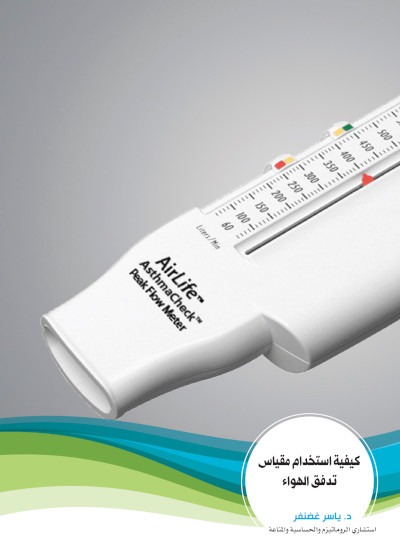
What is a peak flow meter?
A peak flow meter is a handheld device used to measure how well air flows out of the lungs in a “fast burst.” In other words, it is a gauge that measures your ability to push air out of your lungs. Peak flow meters are available in two ranges for measuring air coming out of your lungs. A low-range peak flow meter is for young children, and a standard-range meter is for older children, adolescents, and adults. An adult has much larger airways than a child and needs a larger range.
How do you use a peak flow meter?
-
Step 1: Before each use, make sure the indicator or sliding arrow on the peak flow meter is at the bottom of the numbered scale.
-
Step 2: Stand up straight. Remove any gum or food from your mouth. Take a deep breath. Place the peak flow meter mouthpiece in your mouth. Close your lips tightly around the mouthpiece. In one breath, exhale as hard and as fast as you can.
-
Step 3: The force of the air coming out of your lungs moves the indicator along the numbered scale. Write down the number on a sheet of paper.
-
Step 4: Repeat the entire procedure three times.
-
Step 5: Record the highest of the three readings. Do not calculate an average. This is very important.
-
Step 6: Measure your peak flow at approximately the same time each day. You and your doctor can determine the best times. Suggestions include measuring peak flow twice daily between 7-9 AM and between 6-8 PM.
-
Step 7: Keep a chart of your peak flow readings and discuss the readings with your doctor.
Why is it important to use a peak flow meter regularly?
-
Regular use is important because the readings will help you recognize when your lungs are not working at their full capacity, which may mean you are heading toward an asthma attack.
-
It helps your doctor determine how well your asthma medications are working.
-
It can be used to help identify what triggers your asthma symptoms by taking readings before and after exposure to suspected triggers.