

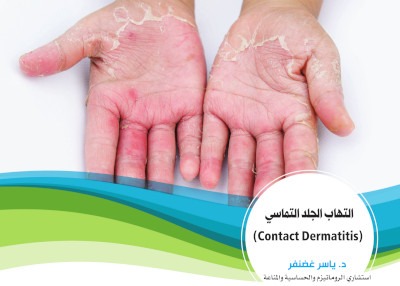
Contact Dermatitis
What is Contact Dermatitis?
Allergic contact dermatitis is an inflammation of the skin that causes redness in the affected area, accompanied by intense itching which further increases the redness. There are several types of allergic skin inflammation. However, this skin inflammation is classified into two main types:
1 – Skin inflammation caused by a problem from “inside” the body. For example, Atopic Eczema is a common condition that tends to occur and usually affects most members of the same family.
2 – Skin inflammation caused by a problem from “outside” the body. This usually causes patches of inflammation in areas of skin that come into contact with the triggering substance. This is what is referred to as “Contact Dermatitis.”
What are the Different Types of Contact Dermatitis?
There are two types of contact dermatitis:
(1) Irritant Contact Dermatitis
This is caused by direct contact with a skin-irritating substance. It significantly affects the hands. Irritants are substances that can cause inflammation in almost everyone if they are in contact for a sufficient period of time — repeated often enough — and at a strong enough concentration.
Examples include:
– Chemical detergents (Detergents) such as dishwashing liquid and various soaps
– Solvents such as petroleum
– Alkalis, including cement
(2) Allergic Contact Dermatitis
This occurs when the immune system reacts to a specific substance, which is then called an allergen. Only a small amount of the allergen trigger is needed upon contact with the skin to cause a rash.
There are several substances that can cause allergic contact dermatitis, including the following:
– Nickel, which is found in many metals — for example, jewelry, decorative buttons used on clothing, shoes, and decorative straps.
– Cosmetics: particularly perfumes, hair dyes, sunscreens, and nail polish.
– Additives in leather and rubber products (in shoes, clothing, etc.)
– Preservatives in creams and cosmetics.
What are the Symptoms of Allergic Contact Dermatitis?
The signs and symptoms of allergic contact dermatitis include the following:
– A rash or raised red bumps
– Itching, which may be severe
– Dry, red patches that may resemble a burn
– Fluid oozing from broken skin in severe cases
– A rash confined to exposed areas of skin
– Pain and tenderness at the site of infection
When Should I See a Doctor?
See a doctor in the following cases:
1- If you feel uncomfortable due to sleeplessness or feeling distracted when carrying out daily routine activities.
2- Feeling pain in the skin.
3- If you suspect there is inflammation and skin infection.
4- If you have attempted self-care steps without achieving notable success.
5- If you suspect there is a connection between the skin inflammation and the nature of your work.
Do I Need to Have Tests Done?
Your doctor may diagnose allergic contact dermatitis after speaking with you about your signs and symptoms and examining your skin. If the cause of the rash is not clear, or if the rash recurs frequently, your doctor may recommend a patch test (Patch Test).
During the patch test, small amounts of potentially allergenic substances are applied to small patches, which are then placed on the skin to check for a reaction. The patches remain on your skin for three days before being evaluated by the doctor. If you are allergic to a particular substance being tested, you will develop raised bumps or a limited skin reaction only under the patch.
What is the Initial Treatment for Allergic Contact Dermatitis?
– If the skin is not severely affected, then using a moisturizer (emollient) frequently may be all you need until the inflammation settles and the rash clears.
– Topical steroids — creams, ointments and preparations containing steroid medications. They work by reducing inflammation in the skin. Topical steroids are usually applied twice daily until the inflammation disappears. This may take up to two weeks or more.
– An antibiotic may be prescribed if the affected area becomes infected. This is uncommon in most episodes of allergic contact dermatitis.
– Rarely, a course of steroid tablets may be needed if you have a widespread and severe area of skin inflammation.
What Can I Do to Reduce Allergic Contact Dermatitis?
– Try to identify and avoid the substances that irritate the skin or cause an allergic reaction.
– Apply an anti-itch cream or Calamine Lotion to the affected area.
– Taking an oral antihistamine (Oral Antihistamine), such as Diphenhydramine, may be helpful if the itching is severe.
– Avoid scratching as much as possible.
– Apply cool, wet compresses.
– Take a comfortably cool bath.
– Wear cotton clothing.